


VIDEO: How Medicare Part D Works (2027)
2027 Medicare Part D prescription drug coverage has the same design as 2026, but with an increased deductible ($700) and max out-of-pocket limit ($2,400 *).
Plus…
15 additional high-cost drugs have been negotiated down in price by Medicare. These include:
Ozempic, Wegovy, Rybelsus
Trelegy Ellipta
Breo Ellipta
Tradjenta
Janumet
Xtandi
Pomalyst
Ofev
Ibrance
Linzess
Calquence
Austedo
Xifaxan
Vraylar
Otezla
This means you should see lower overall costs for these medications in 2027, depending on your plan’s coverage design.
Watch our video on how this works, or read the next section below.
* NOTE: Only COVERED medications on your plan’s formulary list of drugs are counted toward the $2,400 cap.
2027 Medicare Part D Prescription Drug Coverage
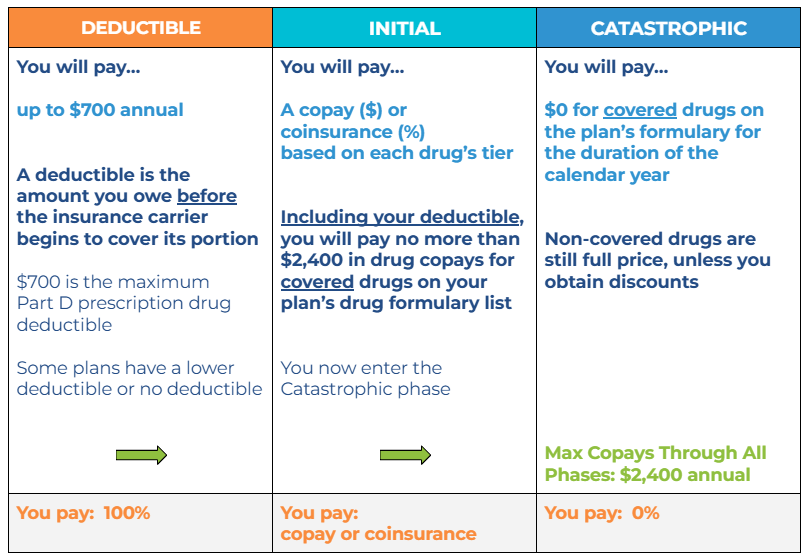
Let’s Review Each Of The 3 Phases. As You Read The Descriptions, Reference The Visual Above...
Deductible
This is the period where you must pay a certain amount of prescription costs before your Part D plan kicks in. The maximum deductible a Part D plan can have is announced each year by Medicare. In 2027, the maximum deductible is $700. That doesn’t mean it’s the maximum you’ll pay all year, rather it’s what you owe initially before your plan begins to help pay a portion of your drug costs. Some Part D plans have the full $700 deductible, some have a lower deductible, and some don’t have a deductible at all.
Initial Coverage
Assuming your medications are on your plan’s formulary list of drugs, this is when your Part D plan begins to pay the bulk of a drug’s cost. It’s “Tier-based” pricing. Typically, generic drugs are Tier 1 or Tier 2...and then, brand name drugs are Tier 3, Tier 4, and specialty drugs are Tier 5. But every plan can choose a different tier structure. You will pay tier-based pricing until you reach the cap of $2,400 (including your deductible)…which means you’ve reached the Catastrophic phase.
Catastrophic
As indicated, once you reach $2,400 in copays (including your deductible), you no longer pay any copays for COVERED drugs on your plan’s formulary list of medications.
Reference Links
www.medicare.gov

